CALL SHEET DAILY · Company research
Beverage check: FIZZ is selling fewer cases and earning less on each sales dollar
Call Sheet Daily · Quarterly beverage snapshot · September 12, 2026
FIZZ’s flat sales conceal a weaker business: case volume fell 6.4% while realized price per case rose 7.1%. Costs per case increased 12.4%, and operating profit fell 17.4%. Several beverage peers grew volumes and profits through the same broad cost environment. FIZZ filing
The quarterly comparison
All changes below are year over year. The measures and business scopes are deliberately labeled.
| Company / quarter ended | Demand or sales signal | Profitability signal |
|---|
| FIZZ · Aug. 1 | Case volume −6.4%; sales +0.04% | Operating profit −17.4%; operating margin −373 bps to 17.7% |
| KO · July 3 | North American unit cases +3%; global cases +5% | Global operating profit +9%; operating margin +80 bps |
| KDP · June 30 | U.S. Refreshment volume/mix +6.5%; segment sales +10.0% | U.S. Refreshment adjusted operating profit +11.9% |
| MNST · June 30 | Global energy-drink cases +22.3%; total sales +20.2% | Operating profit +17.2%; operating margin −73 bps |
| PEP · June 13 | North American beverage volume −4%; segment organic revenue +1% | North American beverage core constant-currency operating profit flat |
| CELH · June 30 | Total sales +11%; CELSIUS brand revenue −11.7% | Gross margin −340 bps; adjusted EPS −23% |
Sources: FIZZ, Coca-Cola, Keurig Dr Pepper, Monster, PepsiCo, Celsius.
FIZZ’s demand weakness stands out. Its case decline was deeper than Pepsi’s North American beverage decline, while Coke’s North American system and KDP’s refreshment business expanded. Monster’s global energy growth provides a stronger-growth reference, although its category and geography differ. These are operating comparisons, not a calculation of LaCroix’s market-share loss; FIZZ does not provide standalone LaCroix volume here.
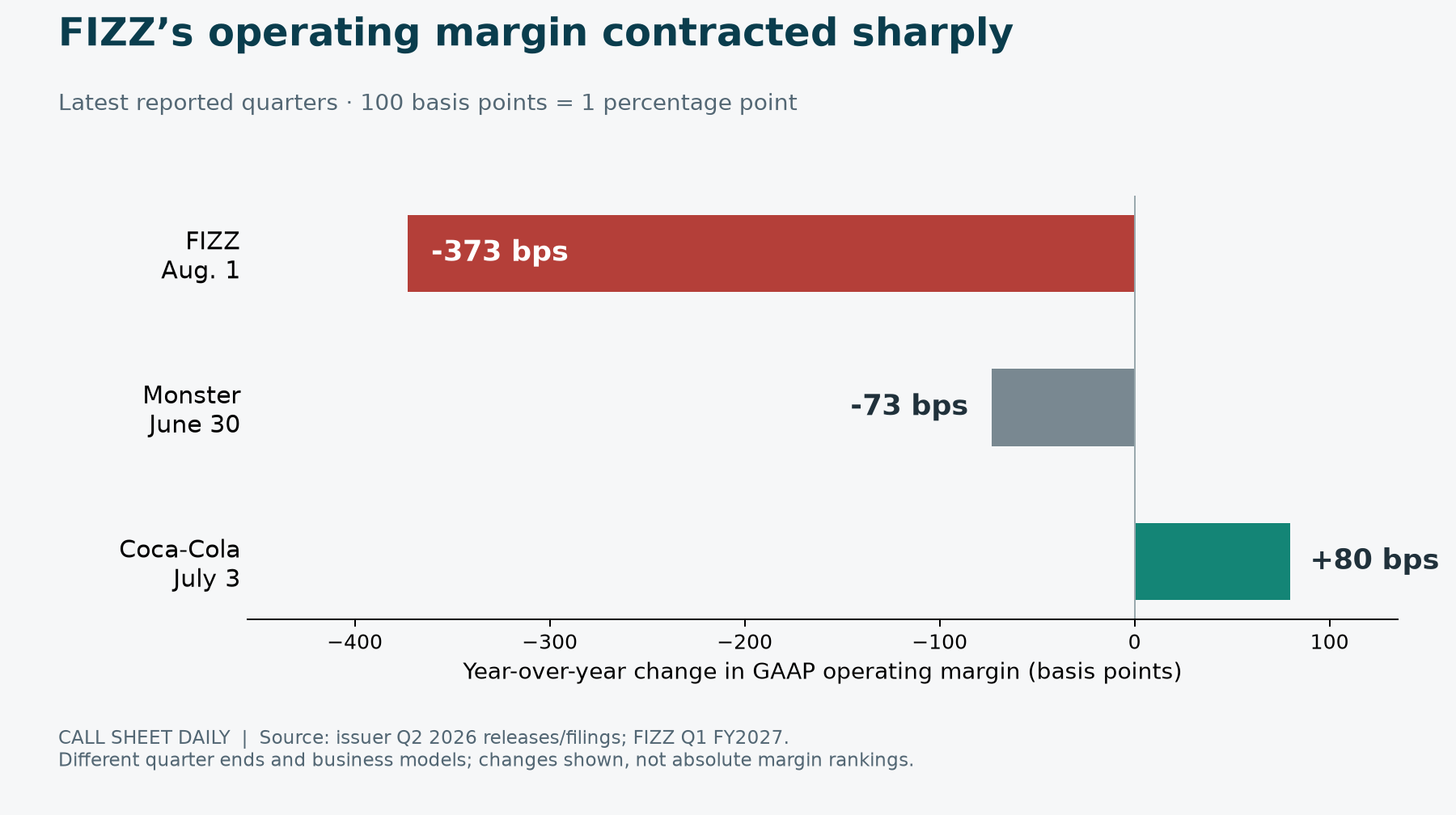
The margin damage is substantial. FIZZ’s operating margin fell about 3.73 percentage points, compared with a 0.73-point decline at Monster and a 0.80-point increase at Coke. Margin changes are more informative than comparing absolute margin levels across concentrate, bottling and energy-drink business models. Calculations use operating profit divided by revenue. FIZZ, Monster, Coke.
Hedging cushioned the decline. FIZZ recognized $5.026 million after tax, or approximately 5.37 cents per diluted share, from hedge gains released into earnings—about 10.7% of quarterly net income. Monster’s comparable recorded commodity benefit was approximately $13.987 million after tax, or 0.71 cent per split-adjusted share, about 2.4% of net income. Monster’s quarter is calculated as first-half reclassification less Q1. These are recorded gains, not estimates of either company’s entirely unhedged economics. FIZZ Note 5, Monster Q2, Monster Q1.
What would change the picture?
Coke raised its full-year outlook. Pepsi maintained 2–4% organic revenue growth and 4–6% core constant-currency EPS growth. KDP retained a low-double-digit constant-currency adjusted EPS target, with tariff-refund assumptions complicating the earnings bridge. FIZZ described an August order rebound without quantifying it. Orders need to become sustained shipments, retail sell-through and margin recovery before that narrative becomes evidence. Coke, Pepsi, KDP, FIZZ release.
There are meaningful exceptions. Celsius also suffered margin and earnings pressure; its consolidated growth includes a changed acquisition perimeter and must not be mistaken for organic case growth. Pepsi’s North American demand was weak, and KDP’s coffee business also declined. FIZZ’s cash generation improved: operating cash flow rose 9.8%, although a larger prepaid/other-asset cash release helped. The evidence supports underperformance in demand and operating profitability, rather than a claim that FIZZ is worst on every measure. Celsius, Pepsi, KDP, FIZZ.
Period and measurement notes: FIZZ is fiscal Q1 2027; the others are Q2 2026. Quarter ends range from June 13 to August 1, so these are the latest reported quarters, not synchronized observations. KDP volume/mix is not pure case volume. CELSIUS brand revenue is a dollar measure, not volume. KO volume reflects its bottling system; MNST excludes Alcohol and Other from energy cases. Adjusted, core and organic measures are non-GAAP. This snapshot assesses operating performance, not valuation or accounting misconduct.
Read and share this comparison on Substack →